
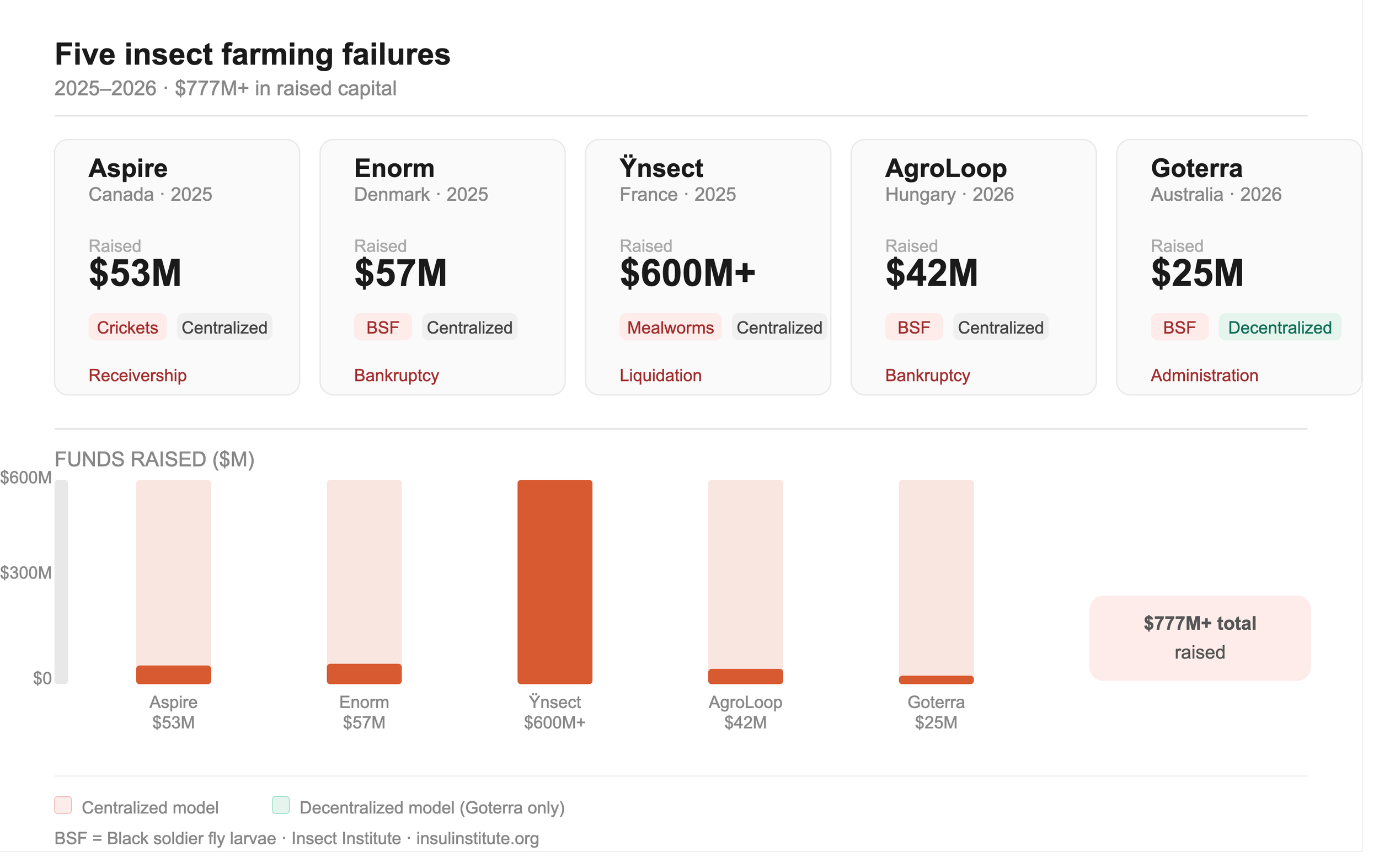
$777 million invested; five failed insect farming companies. What happened?
Industry analysis
From a 150,000-square-foot cricket facility in Canada to a "robot"-based waste-processing model in Australia, the past two years have seen a string of high-profile collapses across the insect agriculture sector. Here's what happened.
Aspire Food Group
Canada · May 2025
Aspire operated the world's largest cricket farm — a 150,000-square-foot, fully automated facility engineered to house billions of insects and produce millions of kilograms of protein annually. By June 2024 it was running at roughly half capacity and needed tens of millions more just to attempt a production ramp-up. Farm Credit Canada was owed ~$41 million at receivership; Agriculture and Agri-Food Canada had contributed a further $8.5 million. However, there was “[a] mismatch between the scale investors bet on and a market for eating insects that never fully materialized.”
↗ CBCEnorm
Denmark · November 2025
Designed to produce around 11,000 tons of protein meal annually, Enorm's facility was set to be the largest insect farm in Northern Europe, and one of Europe's largest insect agriculture operations in general — behind only Innovafeed's 15,000-ton French site and Protix's 14,000-ton Dutch facility. Backers included Danish agricultural co-operative DLG, which invested in 2022. After a failed reconstruction process, the company declared bankruptcy in November 2025. In a LinkedIn post, the head of biological R&D said about the failure, "unfortunately, sales were not as expected."
↗ AgFunderNewsŸnsect
France · December 2025
The best-funded insect farming company in the world, Ÿnsect raised over $600 million before entering judicial liquidation. High energy costs, persistent technical issues at its main factory, and uncompetitive pricing for its mealworm protein proved impossible to overcome at scale. The company's collapse has renewed debate about whether industrial-scale insect farming can ever be commercially viable.
↗ TechCrunchAgroLoop
Hungary · January 2026
AgroLoop's trajectory is a precise case study in the sector's capital trap: construction of a large insect protein plant consumed available funds before production reached commercial scale, and once operational, revenues could not cover financing costs. By the end of 2024, cash had fallen from ~€6 million to ~€300,000 while liabilities climbed from ~€500,000 to ~€12.5 million. Emergency loans approved in late 2025 were not enough.
↗ Mai KurirGoterra
Australia · June 2026
Goterra was the only entrant here to try a genuinely different approach: a decentralized model in which modular units — "robots" — were deployed at customer sites to process organic food waste using black soldier fly larvae over a 10-day autonomous cycle. Customers paid gate fees; mature larvae were harvested for protein and residual material became fertilizer. The model's collapse raises pointed questions about whether decentralized models based around waste management can solve the financial problems faced by the industry.
↗ AgNavigator